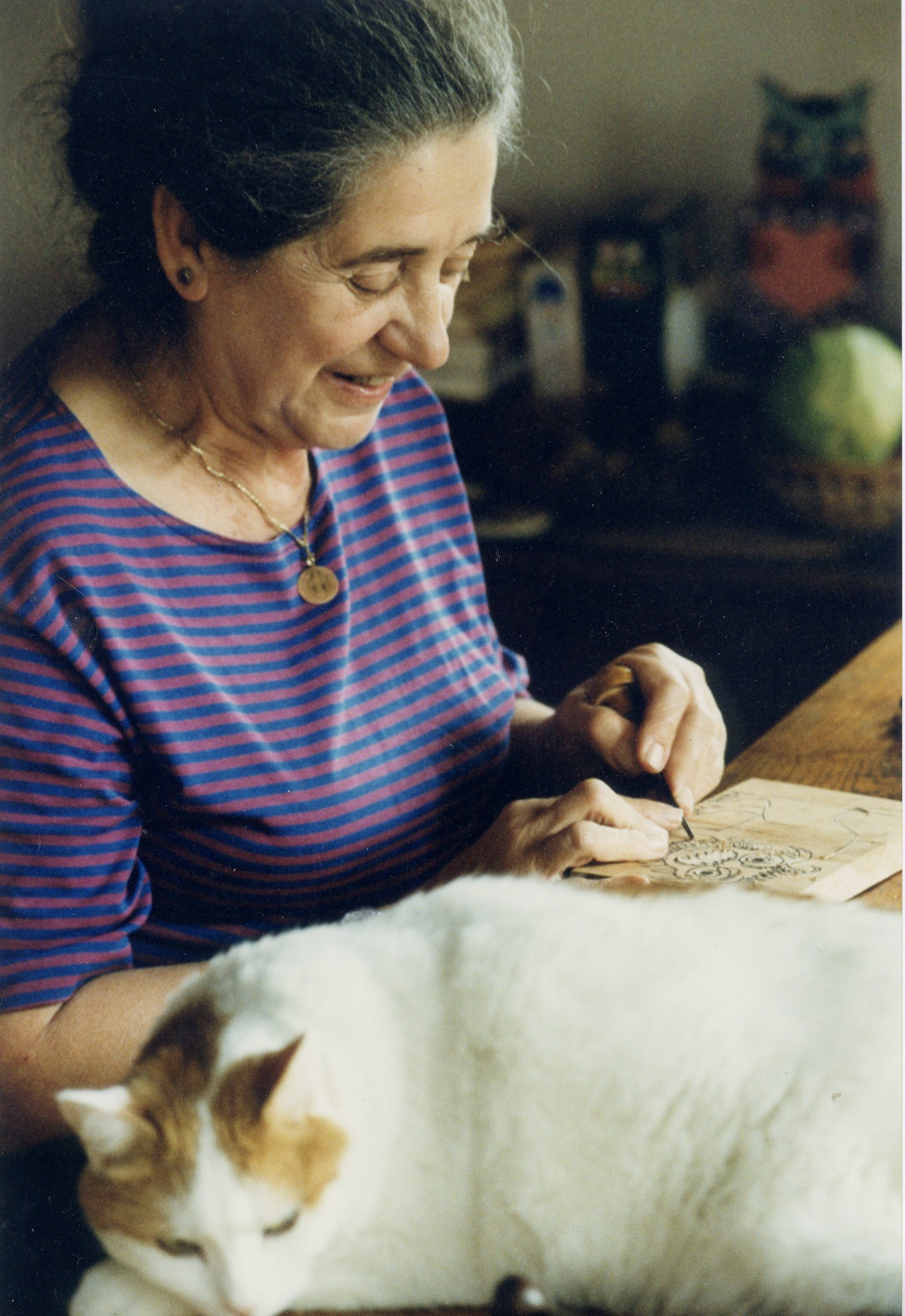
1924-2009 · Austrian-born printmaker, illustrator, and religious artist
Helen Siegl transformed a life marked by war, migration, family, faith, and solitude into an art of spiritual abundance. Her prints bring children, saints, animals, plants, angels, and biblical figures into a shared world of motion, mercy, and wonder.
Helen Siegl was born in Vienna and formed as an artist in the shadow of Nazi annexation, World War II, and the postwar occupation. Rather than letting violence and loss harden her vision, she developed an art of compassion, gratitude, and spiritual imagination. Her mature work is known for relief prints and book illustrations that join folk-art warmth with disciplined graphic design.
Siegl spent much of her adult life in the United States. After marrying Theodor Siegl in 1952, she eventually settled in Pennsylvania, where Theodor served as conservator of paintings at the Philadelphia Museum of Art. While raising eight children, she continued to make prints, illustrate books, exhibit widely, and build a body of work that treated creativity as service.
Vienna, War, and Formation
Siegl's imagination was forged in Vienna, a city of music, churches, museums, and immense wartime suffering. She studied architecture and design at the Academy of Applied Arts Vienna under Professor Oswald Haerdtl. Long hours at the Albertina deepened her attention to line, composition, symbol, and the expressive power of prints.
The upheavals of annexation, bombing, occupation, hunger, and fear became part of the moral ground of her work. Her art does not ignore tragedy; it answers it with images of tenderness, unity, and resilience.
Faith and Artistic Vocation
A devout Catholic, Siegl understood art as a way of perceiving and sharing divine mystery. She illustrated for a children's magazine connected with Brother David Steindl-Rast and considered religious life before choosing marriage, migration, and family. Her later friendship with Mount Saviour Monastery continued this lifelong Benedictine thread.
Her prints often feel like small worlds of grace: prophets dance, children rise into circular motion, animals become companions, and nature is rendered with close affection.
America, Family, and Printmaking
After emigrating to Canada and then settling in Pennsylvania, Siegl balanced domestic life with a serious artistic practice. She worked in wood, linoleum, and plaster block, a medium she developed during wartime scarcity. The hand-carved line remained central to her style.
She earned recognition for children's books, religious images, folktales, carols, biblical illustration, and limited editions. Her work appeared in books ranging from Aesop's Fables and Mother Goose to Nigerian and Turkish folktales.
Publications and Exhibitions
Siegl's illustrations reached readers through trade books, liturgical publications, private press works, and clip-art volumes for church use. Her work was exhibited across galleries, colleges, churches, museums, and libraries from the 1950s onward.
The archive currently documents her publications, exhibitions, and collections separately so they can be expanded as more records are cleaned up.
In later life, Siegl moved to rural upstate New York near Mount Saviour Monastery. The move joined solitude, nature, prayer, and work. As long as her health allowed, she walked to the monastery for Mass and Vespers, returning to the studio between those rhythms.
The hillside setting sharpened themes already present in her work: the roughness of nature, the mercy of hospitality, and the belief that beauty and creativity are forms of affirmation.
Style and Legacy
Siegl's prints combine graphic clarity with spiritual play. Her figures are often simplified, rhythmic, and animated by circular movement. She joins the familiar and the mysterious: birds, beetles, saints, children, flowers, prophets, angels, and biblical scenes coexist without strain.
Her legacy lies in this refusal to separate faith from imagination or beauty from responsibility. Having witnessed war and suffering, she made images that point toward community, justice, and the peaceable kingdom.
This biography consolidates local archive material, including the John Kohan Sacred Art Pilgrim summary and the G. Wayne Barr St. Anthony Messenger article now listed in the Articles section.