America, Family, and Printmaking
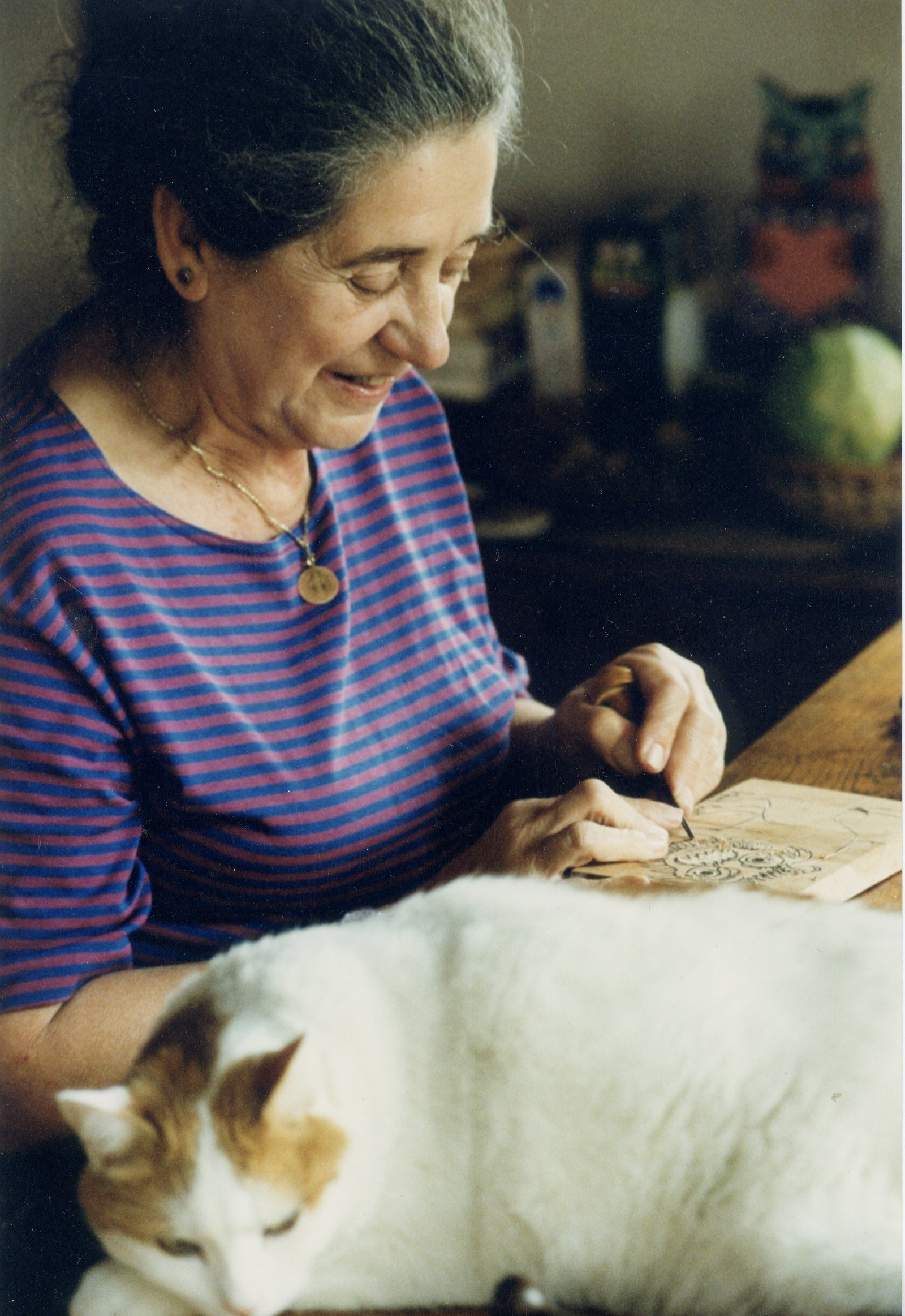
After emigrating to Canada and then settling in Pennsylvania, Siegl balanced family life with a serious artistic practice. She made relief prints from wood, linoleum, and plaster, sometimes combining processes in a single work. During wartime scarcity she devised plaster blocks as a substitute for difficult-to-obtain wood; the method became a distinctive part of her practice and brought wider attention to her work.
The plaster-block technique had an inherent weakness: the plaster could flake during printing and damage the impression. Surviving plaster blocks were varnished to help stabilize and protect their fragile surfaces.
Siegl also experimented with drypoint etching on plexiglass. Although she tried chemical etching, she did not favor the process. Instead, she incised the plexiglass directly, raising delicate plastic burrs that held the ink and produced a crisp first impression. The pressure of the etching press quickly wore those burrs down, however, so each successive impression became lighter. As a result, a plate might yield only two, three, or perhaps four strong impressions.
She also enjoyed working with collagraphs and, in a small number of pieces, combined collagraph, etching, and linocut elements. These adaptable, mixed approaches became especially valuable as arthritis gradually slowed her down, allowing her to continue exploring texture, line, and layered printmaking processes.
In 1975, Helen and Theodor's fourteen-year-old son, Michael, died after living with leukemia for a year. The loss profoundly affected Helen and deepened the spiritual and socially conscious direction of her creativity. Her faith found expression through compassion and advocacy, particularly for people living in poverty and for Black and Native American communities. For Siegl, creativity, spirituality, and social justice became inseparable.
Her illustrations appeared in children's books, religious publications, folktales, carols, and limited editions. Subjects ranged from Aesop's Fables and Mother Goose to Turkish and Nigerian folktales. Her illustrations for Barbara K. Walker's The Dancing Palm Tree and Other Nigerian Folktales were selected for The New York Times Best Illustrated Children's Books of 1990.